Jill

The Beetle

  • Media owner Jill
  • Date added
The Earth Laughs in Flowers by Ilonka Springtime in April by Alexis Designs Butterfly by Aimee Harrison Foliage by GB Ladies Template by J Conlon and Sons (thank you)
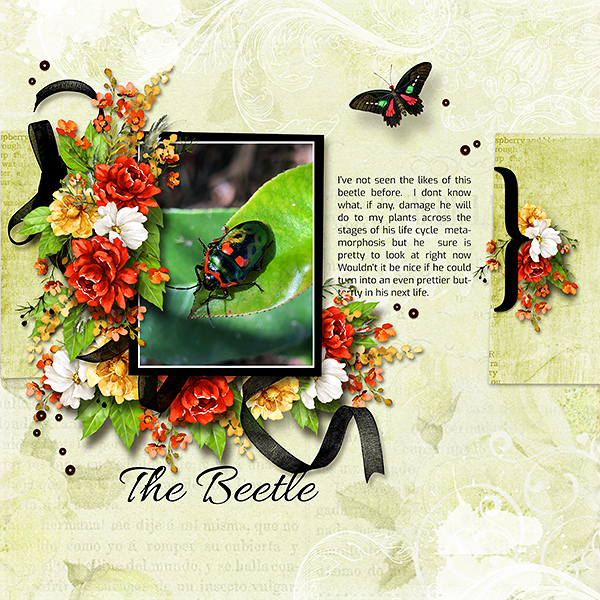
I've not seen the likes of this beetle before. I do
I am pretty sure you have to be a caterpillar to become a butterfly, but it's a cool matching bfly element you found. Your clusters are even more magnificent than usual. I'm over the moon about that brilliant red flower and the black ribbon. I hope this beetle isn't too destructive though, that would be a shame.
 
Wow...those are some MAG TO THE MAX gorgeous clusters! Love how you complimented all the Beetle's queenly colors with variations in the butterfly and flowers. You really should sign up as her home decorator.
Also, you need to relocate her back to the royal palace. Alas..her presence in your garden is like a visit by Wonderland's Queen of Hearts. There is no living happily every after when she's in court. She's only there to select who will lose their heads.
 
What an interesting beetle and great kit choice to match his vivid colors! Love the swirled ribbon woven through the beautiful clusters! Lovely font choice for the title too! TFS!
 
Your kit choice to go along with the picture of the super pretty beetle is beautiful. I enjoyed reading your journaling and I love the thought of a beetle turning into a butterfly.
 
Tectocoris diophthalmus, commonly known as the hibiscus harlequin bug or cotton harlequin bug, is the sole member of the genus Tectocoris and subfamily Tectocorinae. It is a brightly coloured convex and rounded shield-shaped bug with a metallic sheen that grows to about 20 mm. Adult females are mostly orange and males are both blue and red or orange, while nymphs are typically metallic green and purple. The colours are quite variable, and experiments suggest that the variation in colour may reduce bird predation, especially on the immature stages. This extreme level of variation is such that different taxonomists have, since 1781, described this species under different new names at least 16 times, some of these supernumerary names remaining in use until 2006, when it was finally confirmed that they were all colour forms of a single organism. It is common in Eastern Australia, New Guinea and several Pacific Islands in habitats ranging from urban to agricultural and coastal areas>>Hibiscus harlequin bugs feed on many species of the family Malvaceae, as well as cultivated cotton. They will also feed on Illawarra flame tree flowers, Grevillea and bottlebrush saplings.>>They pierce the stems of young shoots and suck the sap. Females lay clusters of eggs around stems of usually the hibiscus plant and then guards them until they hatch.
 

Media information

Category
Template Challenge #3 {2024} Host: J. Conlon and Sons
Added by
Jill
Date added
View count
126
Comment count
5
Rating
0.00 star(s) 0 ratings

Share this media

Back
Top